
Heisenberg's Study Room rents seats to students who study there for weeks at a time. Before anything was built, the counter was answering the same three questions all day, one message at a time. Not hard questions. Just constant ones.
Most people, asked to fix that, would build a form. Name, phone, seat number, submit. It would not have helped, and it is worth being precise about why.
The three questions
Written down plainly, they were:
"Is a seat free?" A student is about to travel across town. They want to know now, not from a screenshot someone sent yesterday. Availability changes through the day, so any answer that is not current is worse than no answer — it sends someone on a wasted trip and costs you their trust.
"I paid. Did you get it?" The student has sent money and a screenshot of the payment. From their side, nothing has happened. Nobody has said yes. They wait a while, get uneasy, and message again. That second message is the counter's cost, and it is caused entirely by the silence.
"When does mine end?" Seats are rented by period. Both sides need to know when a seat runs out — the student so they can renew, the room so it can resell. When that date lives only in a notebook or someone's memory, the room loses money quietly and nobody notices for weeks.
Why a form answers none of them
A form is a way of sending information in. Every one of those three questions is about information coming back out. That is the whole mismatch, and it is why so many businesses install a booking form and find the counter just as busy afterwards.
What a student needs is not somewhere to type. It is a way to see. What is free right now, what happened to the thing they already sent, and what date their seat runs to.
What we built instead
The public page starts with the room, not a blank form. Every seat carries one of six live states — vacant, occupied, expired, payment review, cash hold, or being booked — and the page is the same on a phone as anywhere else, because a phone is where the question gets asked.
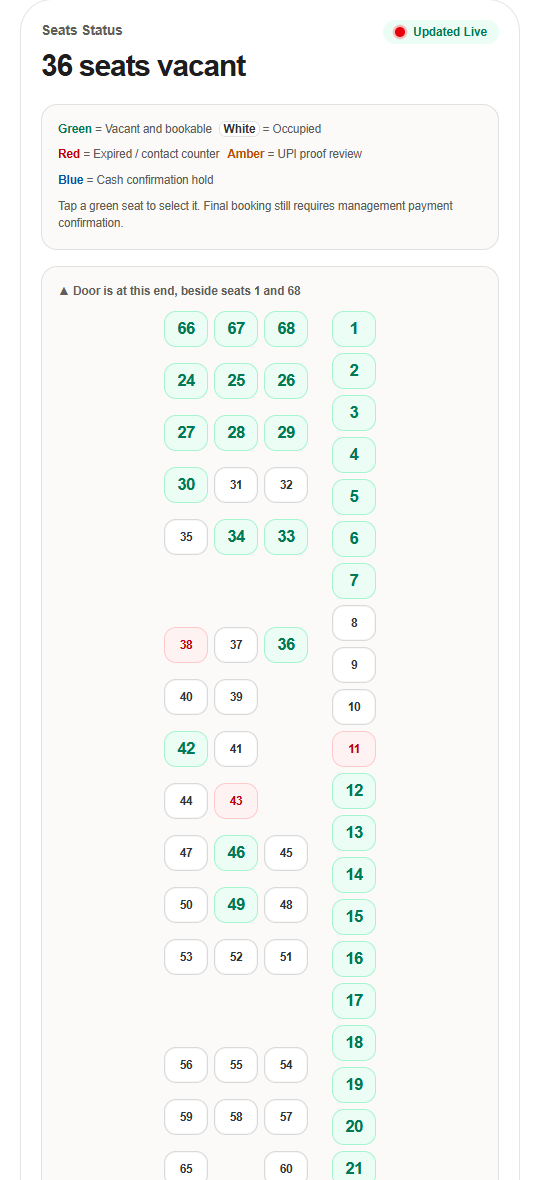
The review states earn their keep. A UPI request moves to payment review. A cash request gets a cash hold. A student completing the booking form gets a short being-booked hold. The seat does not silently stay vacant and it does not falsely become occupied before staff decides.
Staff still confirm every booking by hand. Nothing books itself. For UPI, someone checks payment proof; for cash, the counter confirms payment. The difference is that the deciding is now a short queue of clear items instead of a scroll back through chat.
The part that matters more than the screens
The seat states are only trustworthy because there is one place the answer lives. Before, the truth was split across a notebook, several chats, and what one person happened to remember. Any of those could disagree with the others, and regularly did.
Underneath the page there is now a single record, kept in step with the screen. Nobody at the study room opens it, maintains it, or needs to understand it. That is deliberate. The moment an owner has to keep a sheet tidy for the page to stay honest, you have not removed work — you have moved it and made it someone's evening job.
What this shape fits
Nothing here is really about study rooms. The same three questions turn up wherever a limited thing is booked ahead of time and paid for before it is confirmed: desks, equipment hire, rooms, appointment slots, classes with a fixed number of places.
If you are looking at your own counter and wondering whether a page would help, the useful test is not "do I need a website." It is: what does someone have to ask a person, that they could have seen for themselves? Write those down. If there are three of them and they repeat daily, that list is your first version.
You can look at the finished thing yourself — it is public, and it is a real working build rather than a picture of one.